• Illustration
  • Identity
  • Music
  • Publications
  • Photography
    • Pittsburgh
    • Travel
    • Music
  • About
Michael Artman
  • Illustration
  • Identity
  • Music
  • Publications
  • Photography
    • Pittsburgh
    • Travel
    • Music
  • About

The Branding Iron // USA Today

While I never really saw USA today as a newspaper, the fact is that they were the second biggest distributor of news in the United States. While it always had more of a news magazine flair, the commonly known identity set it apart from the thousands of other newspapers using traditional serif or blackletter type for their mastheads.

I'm not a fan of this old branding. It always felt dated to me, and even if it was the freshest logo on the block, I would not be able to get behind it for a number of reasons. The horribly inconsistent and cramped letter-spacing, the ugly unnecessary trademark symbol that acts as a period, and that globe icon that shows a lot more than the USA which contradicts the namesake... these are all things that make my head hurt. If any publication was in need of a makeover, it was USA Today, so when a big name like these guys announced they would be rebranding, I was certainly interested to see what a newspaper of the 21st Century might look like.
This is the best they could come up with? Using the latest design trend? As many of us have seen, having a dynamic logo that can take a number of forms is the new kid on the block. Everyone wants to be buddies with the new guy. The new guy is so clever and witty! This bland mark for the paper's update can take just about any form. See the detail below:
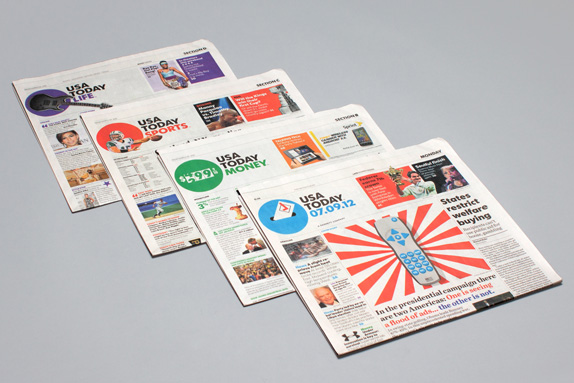
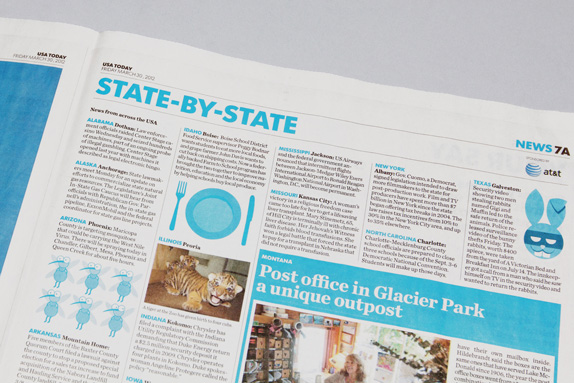
In my mind, this style of design is lazy design. Sure, it might take a lot of work to set up the styles and guidelines for this type of branding, but it requires no thought. No one is sitting down thinking "what is the one perfect mark we can create to make people buy into this brand". It is lazy because there is no design work - anything can be the USA Today logo. Who knows, maybe there is more to it than that. Im sure there is, and I am just looking ignorant, but regardless, I can at least say that I am not a fan. I do however, applaud the designers for at least having the sense to add some much needed spacing between those letters. They needed some room to breathe, and speaking of breathing, what a sigh of relief to see someone using Futura instead of Gotham on a redesign. Another applaud I can give these folks is for nice balance. All too often the weight is too heavy towards the icon or the wordmark, and the eye gets confused. Here, we've got a pretty concise, unified identity with elements that play nice with one another. But, I've got just enough time for one more complaint to finish things off here - why does USA Today, or any newspaper/magazine need anything more than a wordmark at all? Look at how great their new identity looks within the pages of the paper. Bold headlines, bold colors... why not get rid of that silly circle? Typography is a huge problem in many papers, and these folks nailed it.
categories: Identity, Graphic Design, Branding
Wednesday 09.19.12
Posted by Michael Artman
 

Olympic Gold

With the 2012 Olympic Games rapidly approaching, I keep seeing that monstrosity of a logo all over the place. Olympic Games are notorious for having badly designed logos, or at least boring uninspiring logos. I decided to take a look at the history of Olympic logos, and share my 3 favorite as well as my 3 most hated (aside from this year's logo).

Starting with my 3 least favorite (again, aside from this year's design):

The '72 Munich logo is certainly a love/hate for me, as I personally love the design and aesthetic of the piece. However, I am a firm believer that Olympic logos should contain the Olympic rings (I believe they are required to now-a-days) Although this is a great eye-catching design, when viewed out of context, I would really have no idea what it was for. Its a shame to see a great design be so un-useful.

My second selection is the '72 Sapporo Winter Games logo. None of the elements individually irk me, but I think the obvious question is where are they going with this? Is it just me, or is this 3 separate logos glued together. Additionally, that stroke rubbing the Olympic rings and the type is just all too touchy-feely for my likes.

Finally we've got the '94 Lillehammer Games. Not much to be said outside of mentioning that it certainly looks like a logo that would pop up prior to a movie I am watching.. and I don't think Lillehammer is in the film production biz. Again, not terrible work.. but it doesnt make any sense to me.

Picking my 3 favorite was a bit easier. Certainly a smaller selection to choose from, and these 3 were the big winners:

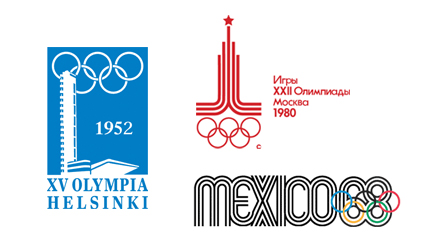
The '52 Helsinki Summer Games is a wonderful logo that manages to stay simple and capture the uniqueness of the city at the same time. My only concern is that the color makes it feel very "winter" to me... or maybe it is the fact that I never considered Finland a particularly "summer" country. Feeling cold or not, the simplicity is enjoyable - and I bet it would look great on a stamp.

Next, I chose the '80 Moscow Games. I simply love the Cold War era design. I find the logo a bit humorous, as can't help but think that the star at the top represents the Soviet Union as a  super-power... rather than representing the spirit of the game and a podium. Regardless of intent, this is one of the few Olympic logos I've seen that actually reminds me of competition and sport.

Last but not least is the '68 Mexico logo. It is hard not to include a design that has prompted so many positive reviews in the design community. I can't say I love it as much as most, but it really is about as close to actual design that anyone has come regarding Olympic logos. Eye-catching and original to say the least.

categories: Identity, Graphic Design
Friday 01.13.12
Posted by Michael Artman
Comments: 1
 

Bass Fishin'...

Saul Bass is widely regarded as perhaps the best graphic artist of the 20th Century due to his extremely popular motion picture title sequences and posters, as well as his undeniably iconic logo designs. While many of his now famous designs have gone by the wayside as companies expanded, folded, merged, etc., we are still bombarded with Saul's work on a daily basis. I was reminded of this this past week, as a coworker sent out an email regarding the sale of Girl Scout cookies. Saul Bass' Girl Scouts logo has withstood the test of time (mostly - subtle changes have been made) and has been in use for well over 30 years now. The great use of negative space makes it one of my favorite logos I have seen, which got me to thinking - what is my absolute favorite Saul Bass logo? Do I have to pick just one? That is a hard crop to choose from... almost every one I would consider a masterpiece. The standouts include Alcoa, AT&T, Avery, Bell, Continental, Dixie, Exxon, Kleenex, Lawry's, Minolta, and Quaker... just to name a few. My personal favorite? United Airlines.

The United Airlines logo may not be his most original or even his most eye catching design, but when the industry is taken into perspective, United has no competition in my mind. The design just makes sense. A stylized letter "U", the angle of the slanted lines fits perfectly onto the tail of a jet. Maybe it is the usage in general that makes this logo so great in my mind. Something about a design standing over 30 feet tall on the side of a jumbo jet has a certain appeal. The spacing of the parallel lines in combination with the curves of the letter-form create the perfect shape to convey a sense of flight, travel and movement. And who can not love an American made logo on an American made plane that is comprised of red, white and blue with stripes reminiscent of the American flag?

Unfortunately, the design was phased out after 37 years in 2010 as Continental and United merged, and was replaced by the much less inspiring globe icon. Ironically, before Continental adopted the globe icon in the 90's, they too had a pretty nifty Bass logo. But perhaps being replaced by a lesser design makes Bass' work stand out even more.

Although many of Saul Bass' creations have disappeared over the years, there are still plenty out there still in use to remind us of the great artist that he was, and his work will continue to inspire.

categories: Graphic Design
Wednesday 01.11.12
Posted by Michael Artman
 
Newer / Older

© 2010-2026 Michael Artman